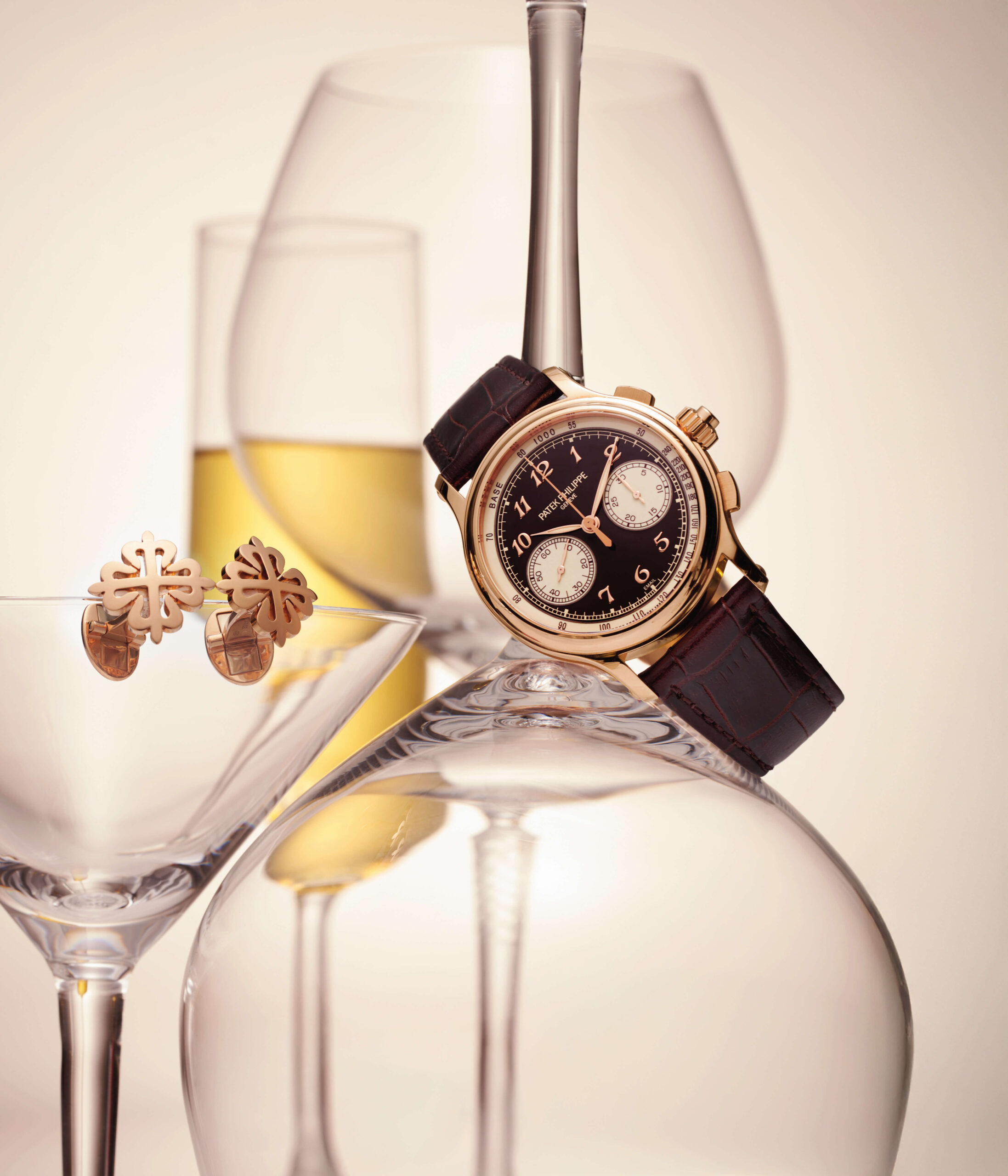
A Century in Split Seconds: Patek Philippe’s Chronograph Legacy
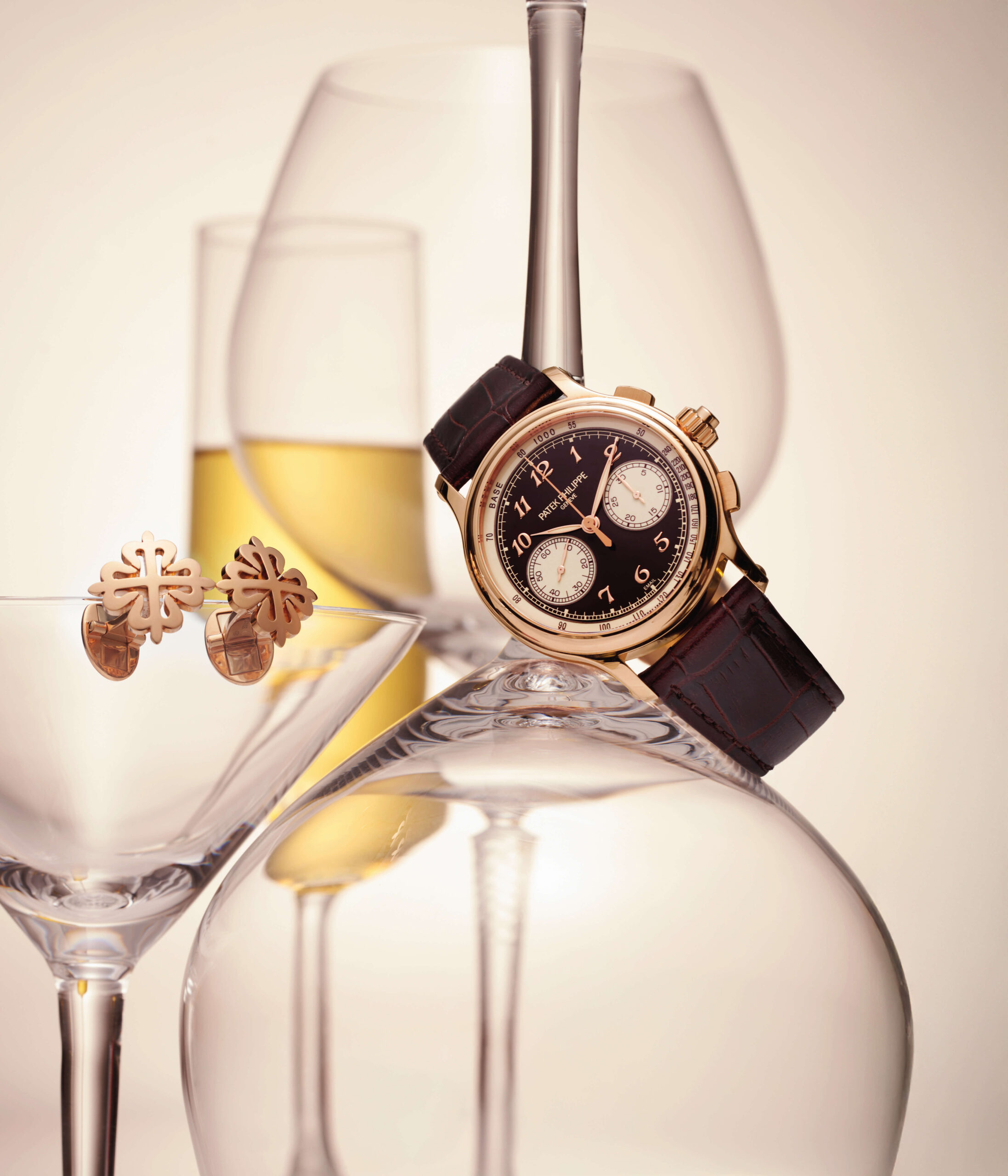
Among the many emblematic complications in haute horlogerie, the split‐seconds chronograph has always held a heightened resonance. It is all at once analytical and poetic: a mechanism created to separate moments that unfold too quickly for the eye, yet dependent on a delicacy of construction that borders on the improbable. Patek Philippe has long treated the split‐seconds not as a technical novelty but as a demonstration of its deepest convictions about watchmaking. The Geneva firm’s finest rattrapante watches express a philosophy of clarity, restraint, and uncompromising craft. From the experimental wristwatch of 1923 to today’s Ref. 5370 split‐ seconds chronograph and the new quadruple complication Ref. 5308, the rattrapante has become one of the clearest through‐ lines in the manufacture’s story.
In the words that follow, we are about explore that very line. It begins with timepiece no. 124.824, sometimes considered the first split‐seconds chronograph made specifically for the wrist. It then traces the rise of the perpetual calendar chronograph with the Ref. 1518, and the parallel evolution of early split‐seconds wristwatches such as the references 1436 and 1563. From there, it moves through the present era of in-house chronograph design, the ultra-thin CHR 27-525 PS, the patent-laden CH 29-535 PS family, and the way these ideas reach maturity in the Ref. 5370 (read the Cover Watch story), Ref. 5204, Ref. 5373 and the Ref. 5308. The aim is to tell the story of the split-seconds chronograph through key references.
1923: THE VERY FIRST WRIST-WORN RATTRAPANTE
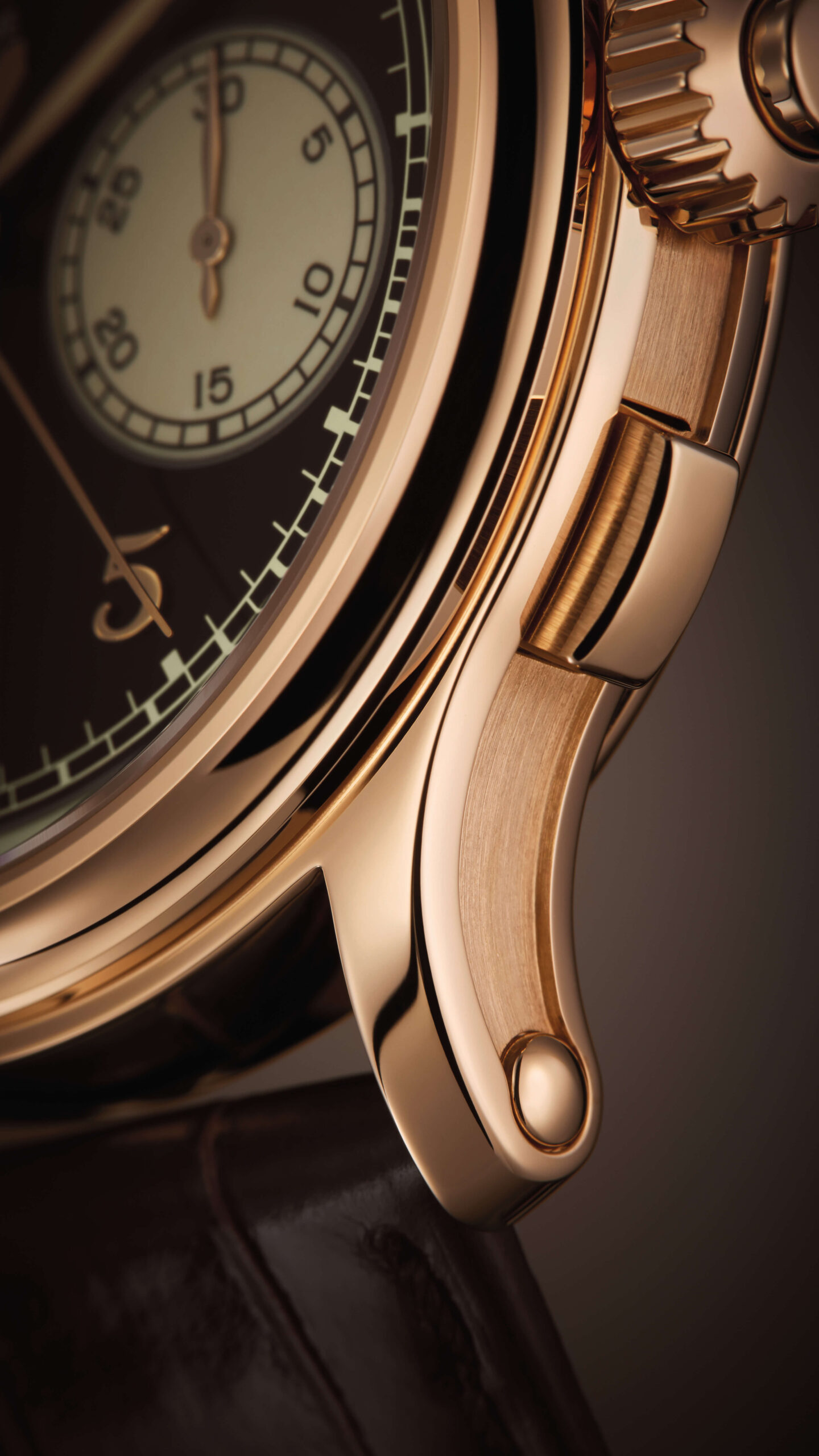
When collectors and scholars discuss the 1923 origins of the Patek Philippe split-seconds wristwatch, they almost always begin with one number rather than a reference: 124.824. The movement within, cased in a 33mm yellow-gold “officer” style wristwatch with an enamel dial and a 60-minute counter, is widely regarded as Patek Philippe’s earliest split-seconds chronograph designed for the wrist.
Mechanically, the challenge of building a rattrapante has always been twofold. First, it doubles the functional burden on the chronograph train by adding a second central chronograph second hand and a split-seconds wheel that must be clamped and released on command. Second, it forces the watchmaker to manage energy and friction in a system that is already parasitic by nature, since the typical chronograph draws power from the going train as soon as it is engaged.
In a pocket watch, the split-seconds mechanism has room to breathe. Levers can be long and gently curved, clamps can be generous, and tolerances can be marginally more forgiving. In a 33mm wristwatch of the early 1920s, the constraints are brutal. The movement in no. 124.824 had to remain extremely thin while accommodating twin column wheels, a layered central chronograph staff, a split-seconds heart and clamp, and a rare 60-minute counter that required more complex chronograph gearing than the usual 30-minute register.
“The message is clear: from the outset, Patek Philippe saw the rattrapante as a field for long-term exploration rather than a passing technical display”
The watch uses a single-button system with the primary chronograph functions controlled through the crown and a separate split-seconds pusher above. The start, stop and reset of the main chronograph are governed by one column wheel, while the split-seconds lever and clamp are controlled by the second. The clamp must grip the split-seconds wheel with enough force to halt it instantly, yet release it without leaving marks on the teeth or disturbing the meshing with the heart cam. Achieving that behaviour in such a compact calibre at the time required tolerances that would have been demanding even in a much larger movement.
What makes 124.824 more than a historical curiosity is the way Patek Philippe subsequently treated it. Nearly a century later, when the manufacture introduced the Ref. 5959 in 2005, its calibre CHR 27-525 PS was explicitly based on the architecture of the 1923 movement, scaled and updated but recognisably descended from the same idea. The message is clear: from the outset, Patek Philippe saw the rattrapante as a field for long-term exploration rather than a passing technical display.
1518: THE PERPETUAL CALENDAR CHRONOGRAPH AS A PATEK PHILIPPE LANGUAGE
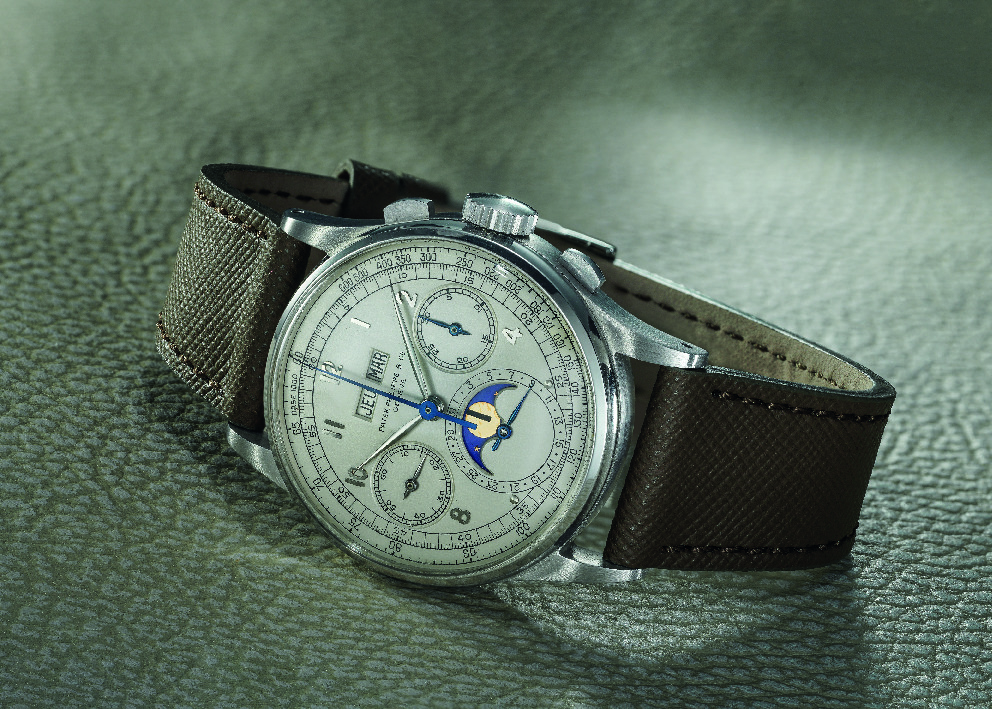
If the 1923 wristwatch established Patek Philippe’s ambition in split-seconds chronographs, the Ref. 1518 defined another of the manufacture’s enduring signatures: the serially produced perpetual calendar chronograph. Approximately 281 examples of Ref. 1518 were produced, with the majority encased in yellow gold, while approximately 20% were cased in pink gold. Scholarship has shown that during the reference’s 14-year production run, a total of only four are publicly known to have been completed and exist today in stainless steel. The earliest instance of this quartet was offered by Phillips recently at its Watches: Decade One (2015–2025) sale on November 8 in Geneva, where, this rarer- than-hen’s-teeth of a timepiece, fetched an unfathomable CHF 14,190,000.
Launched in 1941, Ref. 1518 is widely recognised as the first wristwatch to combine a chronograph with a perpetual calendar in regular production. Its movement was based on a Valjoux 23 chronograph ébauche that Patek Philippe reworked extensively, along with a Victorin Piguet perpetual calendar module, and elevated the finishing to a level expected of a Genevois grand complication.
The watch’s true achievement, however, lies as much on the dial as in the calibre. The 1518 established a visual and functional template that Patek Philippe would revisit for decades: twin chronograph registers at three and nine o’clock, a moonphase and date at six, and twin windows for day and month at twelve.
The calendar works are built around a 48-month cam and a set of levers and jumpers that accumulate energy over the course of the day and release it in an instantaneous change at midnight. For the wearer, the effect is a clean, legible display that hides the complexity of the underlying mechanism.
This reference set the rhythm for an unbroken chain of perpetual calendar chronographs: the 2499, 3970, 5970 and, in the fully in-house era, the 5270 and 5204. Within this family, the 5204 will later become particularly important, because it brings the split-seconds mechanism back into a genre that the 1518 first defined.
EARLY WRIST-WORN RATTRAPANTES: 1436, 1563 AND THE IDEA OF A SERIALLY PRODUCED SPLIT-SECOND CHRONOGRAPH
While the 1518 and its successors pursued the marriage of calendar and chronograph, Patek Philippe also continued to refine the pure split-seconds wristwatch in parallel. But before the split- seconds chronograph became a recognisable Patek Philippe speciality, it appeared in several experimental forms. The earliest wrist expression of this ambition can be traced to Ref. 130, the manufacture’s first serially produced chronograph. While the standard Ref. 130 was a two-pusher, twin-register chronograph powered by Patek Philippe’s reworked Valjoux 23 (calibre 13‐130), a rare few 130s are known to exist in a split‐seconds configuration. These watches, however, did not establish a true lineage.
That true lineage begins with the Ref. 1436, introduced around 1938 and generally considered as Patek Philippe’s first series‐produced split‐seconds chronograph wristwatch. Using a 13‐ligne rattrapante movement derived from the 13‐130 architecture, the 1436 brought the complication into commercial production with approximately 140 pieces created over three decades. Early examples used a system in which the crown itself controlled splitting and reuniting the chronograph seconds hands. Later executions adopted a more robust solution: a co‐axial pusher integrated into the crown, offering crisper engagement and improved reliability.
Housed in what is essentially the Ref. 130 case, Ref. 1436 refined the mechanical logic first seen in the 1923 prototype into something suitable for regular use – and regular production. Where Ref. 1436 was classical, Ref. 1563 represented a rare and energetic variation of the theme. Produced in only a tiny handful of examples – available scholarship cites just three known – Ref. 1563 is effectively a split‐seconds version of the Ref. 1463 “Tasti Tondi”, Patek Philippe’s first water‐resistant chronograph.
Seen together, references 130, 1436 and 1563 trace the earliest contours of Patek Philippe’s split‐seconds identity. Ref. 130 rattrapante reveals the manufacture’s early ambitions; Ref. 1436 establishes the complication as a coherent catalogue reference; and Ref. 1563 shows that the mechanism could inhabit not only elegant mid‐century dress cases but also the more muscular architecture of the “Tasti Tondi”. These watches form the pre‐war and mid‐century backbone of the rattrapante story, an essential foundation for understanding the technical and aesthetic decisions that shape much later references such as 5004, 5204, 5370 and ultimately the 5308.
REF. 5004 — THE LAST GREAT LEMANIA‐BASED RATTRAPANTE
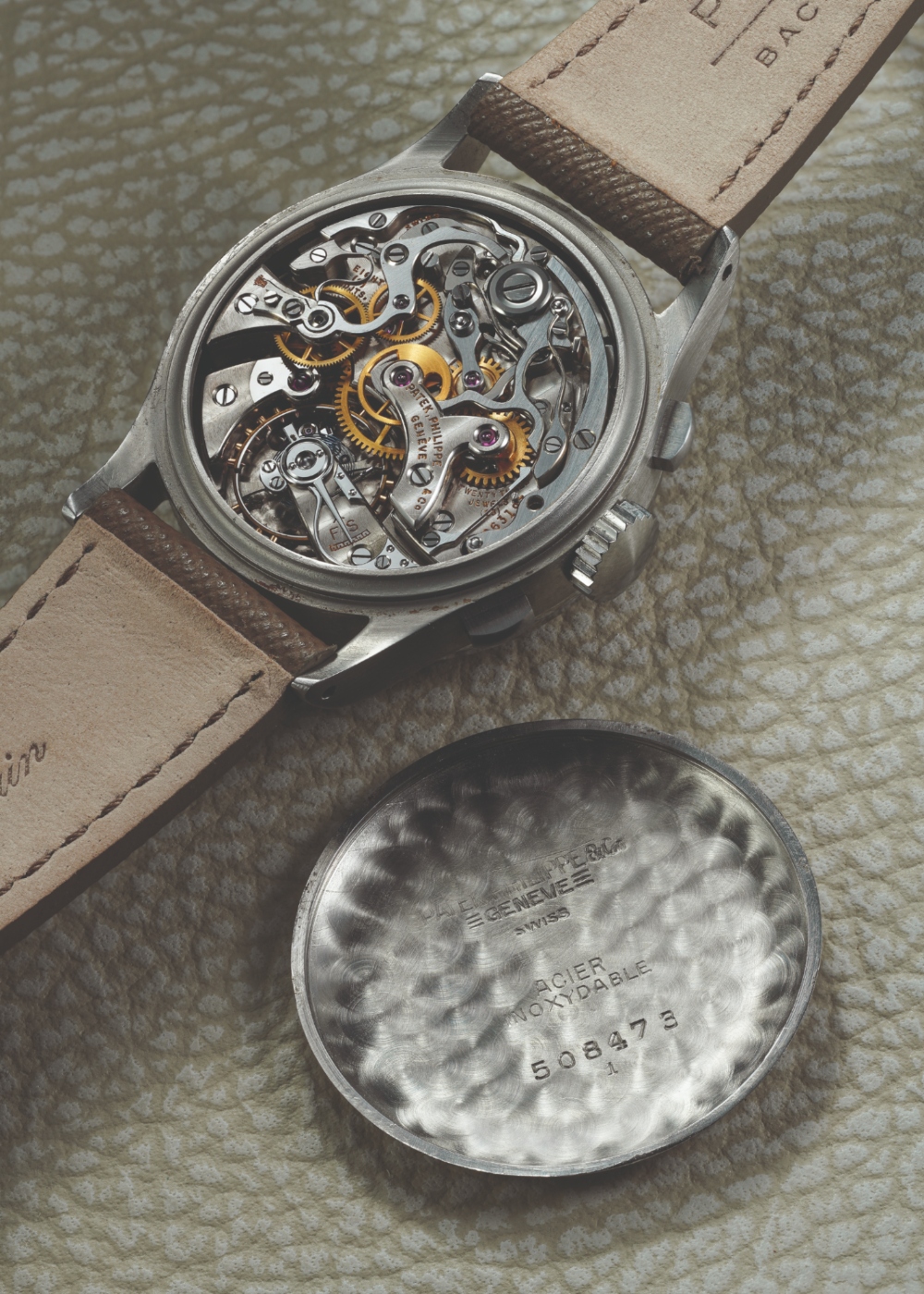
Introduced in 1996, Ref. 5004 was the most mechanically ambitious wristwatch Patek Philippe had ever produced. Built on the blueprint of CH 27‐70 Q, Ref. 5004 added a full split‐seconds mechanism and perpetual calendar to an already dense chronograph calibre. The resulting movement – often cited by watchmakers as one of the most challenging Patek Philippe ever assembled – revealed both the brilliance and the constraints of the Lemania base.
The key innovation was the now‐famous “octopus” isolator mechanism, developed to address the amplitude drop that occurs when a split‐seconds hand is clamped. Earlier rattrapantes, including the 1436, 1563 and even some pre‐production 5004 prototypes, suffered from noticeable drag when the rattrapante wheel halted. The isolator in Ref. 5004 (a multi‐armed, spring‐loaded component that sits atop the split‐seconds column wheel, easily recognisable) disengages the split‐seconds wheel at the moment of clamping. This prevents parasitic load on the chronograph train and stabilises amplitude.
The system worked, but it was extremely complex to adjust. The isolator arms required careful hand‐tensioning, and the Lemania base, which was designed long before Patek Philippe envisioned such a mechanism, did not offer ideal geometry for integration. As a result, Ref. 5004 required intensive regulation to achieve consistent rattrapante performance.
Yet this reference occupies a vital position in this lineage. It represents the boundary of what could reasonably be achieved on the Lemania platform and directly informed the requirements for the next era of Patek Philippe chronographs: lower friction, optimised tooth geometry, a more compact rattrapante layer and an isolator that no longer required the elaborate “octopus”.
“The key innovation was the now‐famous “octopus” isolator mechanism, developed to address the amplitude drop that occurs when a split‐seconds hand
is clamped”
THE FIRST FULLY IN‐HOUSE CHRONOGRAPHS — CHR 27‐525 PS
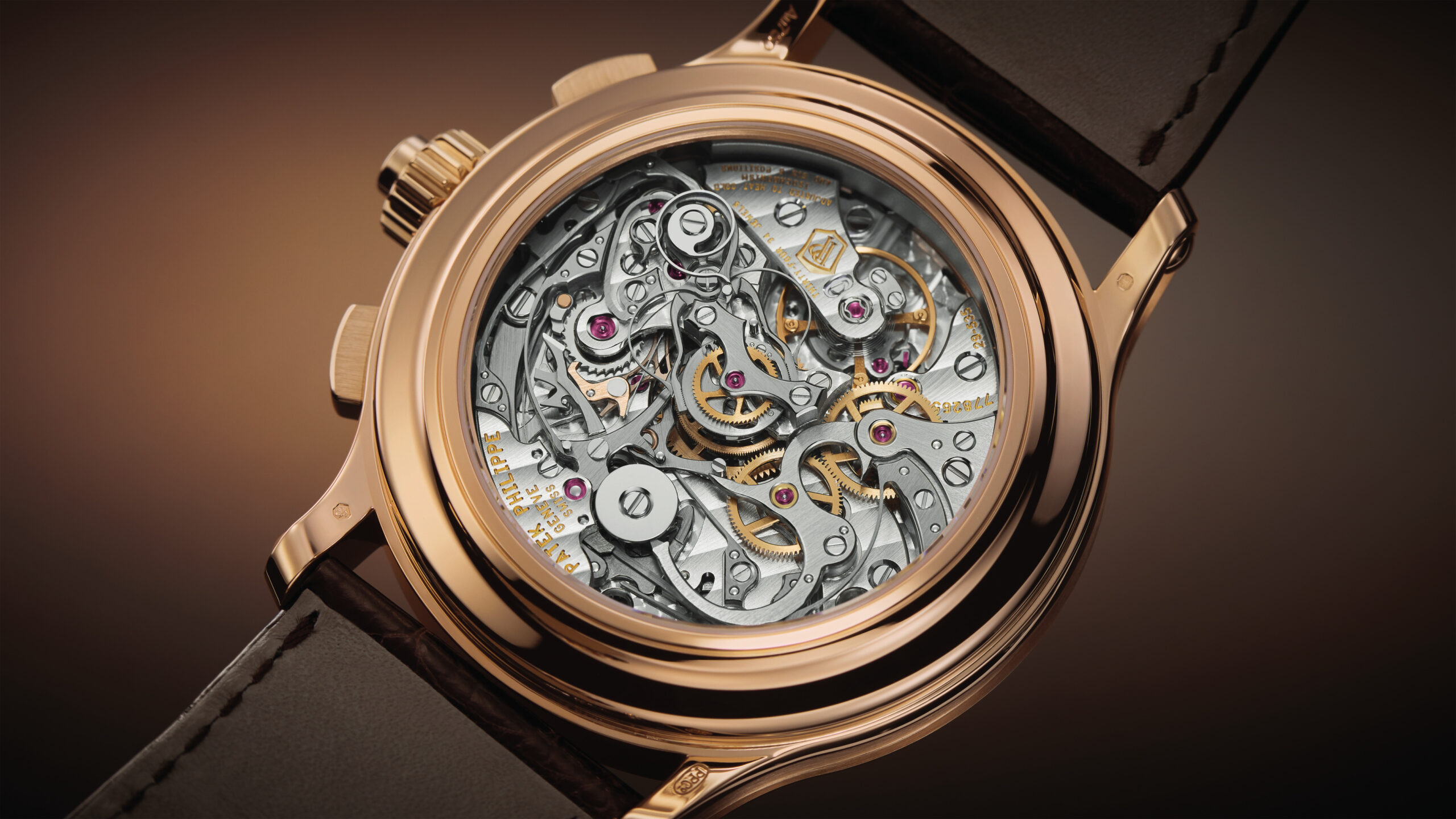
By the early 2000s, Patek Philippe moved decisively towards full independence in chronograph construction. The first milestone was the CHR 27‐525 PS of 2005, the manufacture’s thinnest rattrapante chronograph at just 5.25mm. As mentioned earlier, its architecture deliberately referenced the 1923 wristwatch, with elegantly shaped bridges, classical column‐wheel control and exposed steelwork finished to a high polish.
Just five years later, Patek Philippe added an instantaneous perpetual calendar, creating the CHR 27‐525 PS Q – only 7.3mm high. Used in references such as the 5951, 5372 and now the 5373, it demonstrated that ultra‐thin construction and a full rattrapante could coexist without sacrificing reliability. These calibres prove that Patek Philippe’s interest in split‐seconds chronographs is not only historic but ongoing.
CH 29‐535 PS: PATENTS, TOOTH PROFILES AND THE PRESENT CHRONOGRAPH GRAMMAR
If the CHR 27‐525 PS family represents one branch of Patek Philippe’s rattrapante thinking, the CH 29‐535 PS family represents another. Introduced in 2009, the CH 29‐535 PS was the manufacture’s first fully in‐house, manually wound chronograph calibre without additional complications. It is a traditional column‐wheel, horizontal‐clutch movement in broad conceptual terms, but its details show how carefully Patek Philippe studied the weaknesses of classical chronographs.
The calibre incorporates six patented innovations. The first is an optimised tooth profile for both the chronograph wheel and its driving wheel, designed to suppress hand quiver when the chronograph starts, reduce backlash and increase efficiency. The second uses an eccentric cap on the column wheel to allow precise adjustment of the meshing depth between the clutch and chronograph wheels, turning what was once a decorative cap into an active regulating element. The third synchronises the clutch and brake levers directly via a finger on the clutch lever, rather than relying on separate column‐wheel contacts, which makes timing their actions more precise and simplifies future adjustment.
The fourth patent concerns a slotted minute‐counter cam that allows the minute hand to jump cleanly while minimising the energy impact on the train. The fifth introduces self‐setting return‐to-zero hammers that automatically align themselves to the heart cams, improving reliability over time. The sixth pivots the reset hammers between jewel bearings on a common axis, each with its own spring, enhancing both alignment and long-term stability.
Beyond the patents, the CH 29-535 PS is distinguished by its architecture: broad, gracefully shaped bridges, a large four- armed Gyromax balance beating at 4 Hz, and an instantaneous 30-minute counter that jumps in a fraction of a second. It has become the base calibre for a family of movements, including the CH 29-535 PS Q with perpetual calendar and, crucially for our story, the CHR 29-535 PS and CHR 29-535 PS Q, which add the split-seconds function.
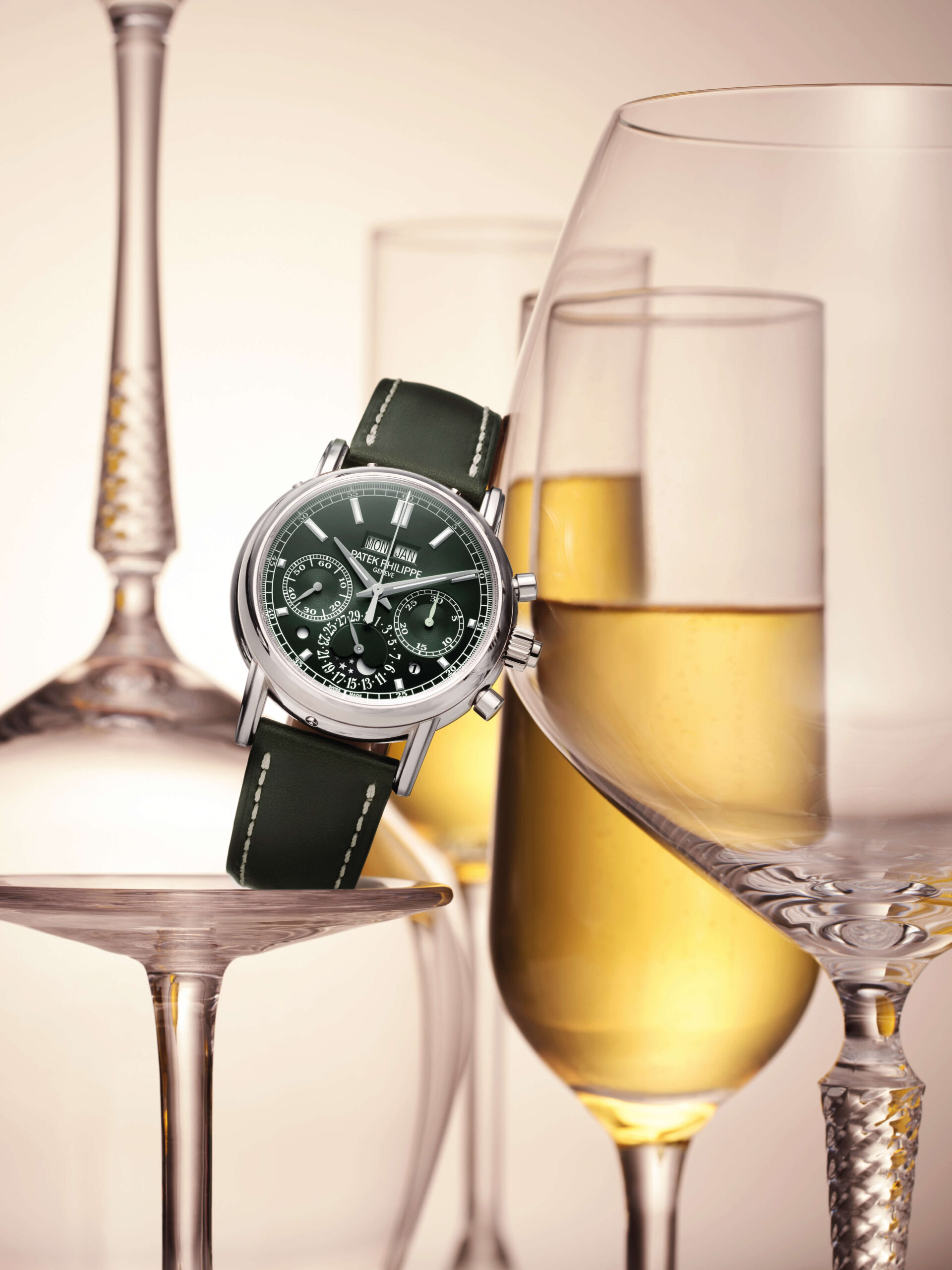
These CH 29-535-derived calibres are the mechanical language through which Patek Philippe expresses its current chronograph thinking. The Ref. 5370 and Ref. 5204 are two of the clearest sentences in that language; as usual with the cover story, see the Cover Watch segment for details about Ref. 5370.
REF. 5204: THE PERPETUAL CALENDAR SPLIT-SECONDS, RE-WRITTEN IN-HOUSE
If Ref. 5370 is Patek Philippe’s purest contemporary expression of the split-seconds chronograph, Ref. 5204 is its most articulate. It is the point where the perpetual calendar chronograph lineage that began with the 1518 intersects with the in-house rattrapante vocabulary of the CH 29-535 PS.
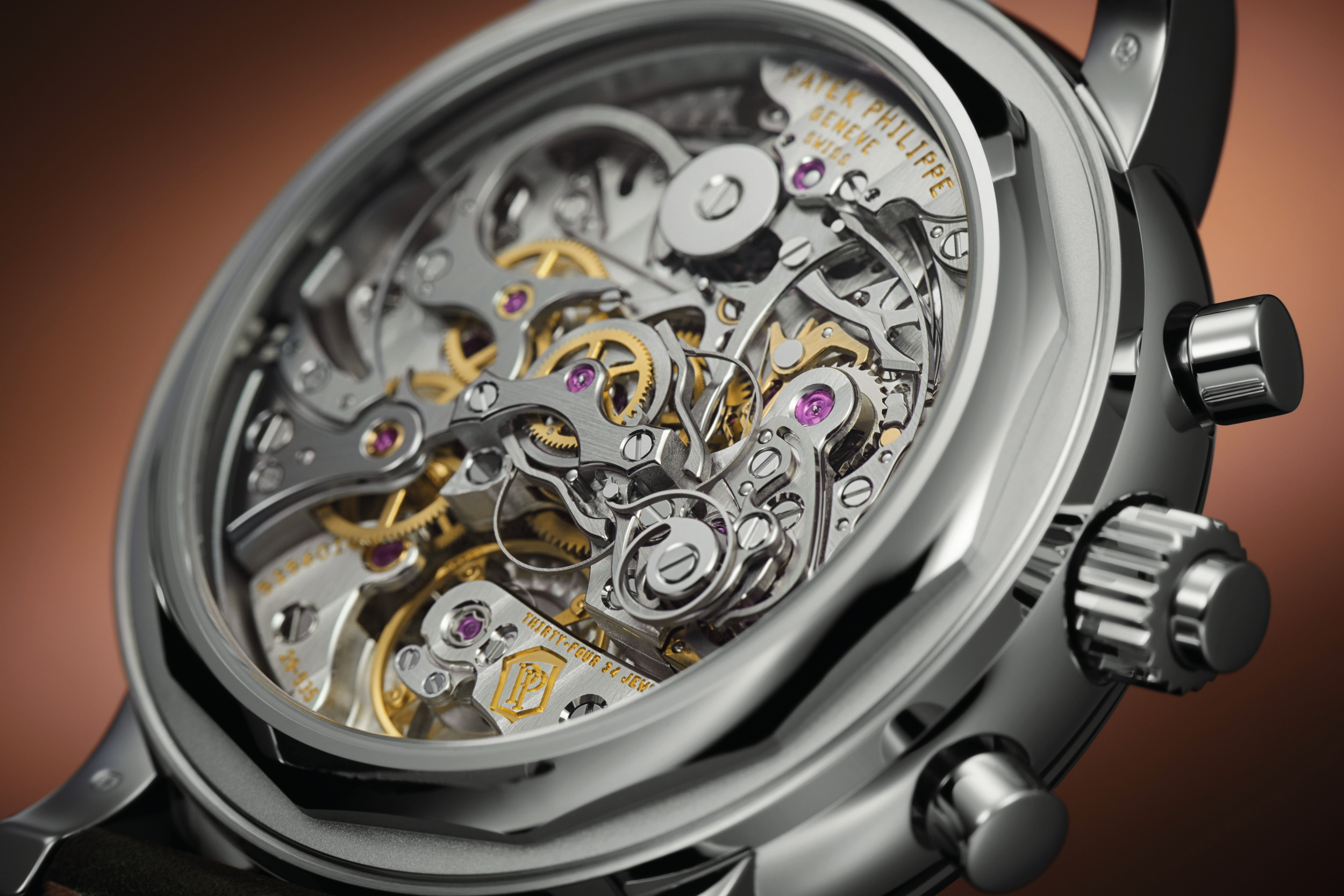
Launched originally in platinum and offered in white gold since 2022 as the 5204G-001, the watch combines a split- seconds chronograph with a full perpetual calendar, moonphase display, day–night indicator and leap-year indication. The movement is the CHR 29-535 PS Q, which takes the base CH 29- 535 PS and adds both the rattrapante mechanism and a perpetual calendar module.
The chronograph side benefits from all six patents of the base calibre. The split-seconds side gains two additional technical advances: an improved isolator for the rattrapante lever and a mechanism that reduces alignment error between the chronograph and split-seconds hands when they are meant to sit directly on top of one another. In the technical notes for Ref. 5204, Patek Philippe explains that the new split-seconds lever features twin flat contact surfaces which mate with corresponding flats on the heart cam recess, improving hand superposition accuracy by roughly three quarters compared with the previous generation.
The perpetual calendar is of the instantaneous-jump type. Energy is accumulated by a cam and spring system over the course of the day; at midnight, that energy is released in a single, coordinated action that advances the day, date, month, leap-year and day–night indications together. The date is displayed by hand, while the other indications appear in apertures. The moonphase display is calibrated for an error of one day in 122 years.
For the wearer, Ref. 5204 is the rational bridge between Ref. 1518 and 21st-century Patek Philippe. It applies the visual grammar established in 1941 to an entirely in-house movement with contemporary chronograph architecture and a split-seconds system that reflects three decades of rattrapante refinement since Ref. 5004. It is also the watch that helps contextualise Ref. 5308G (see below). Where Ref. 5204 answers the question “How far can we take a traditional perpetual calendar split- seconds chronograph in a manually wound format?”, Ref. 5308 asks a slightly different one: “How many of Patek Philippe’s most demanding complications can be made to coexist in an automatic wristwatch without compromise?”
REF. 5373P: THE LEFT-HANDED DETOUR
Before we reach the 5308G, one more split-seconds chronograph deserves mention, because it illustrates Patek Philippe’s willingness to re-think ergonomics even at the highest level of complication.
The Ref. 5373P-001 is a split-seconds monopusher chronograph with perpetual calendar, designed with its crown and pusher set on the left of its case. Inspired by the earlier 5372P, it rotates the crown and chronograph monopusher to nine o’clock and the split-seconds pusher to eight o’clock. The dial indications are turned through 180 degrees so that the date sits at 12 o’clock, seconds at 3, moonphase at 6 and 60-minute counter at 9.
Inside, the calibre is the CHR 27-525 PS Q, the ultra-thin split-seconds chronograph with perpetual calendar introduced in 2010 and now reserved exclusively for this reference. At 27.3mm in diameter and 7.3mm thick, it remains Patek Philippe’s thinnest movement combining these functions. The architecture relies on twin column wheels with polished caps, a 60-minute counter rather than the more common 30-minute register, a Gyromax balance at 3Hz and a perpetual calendar module that adds only 2.05mm in height to the base chronograph.
As a watch, Ref. 5373P is more extroverted and sporty than references 5370 or 5204, with its charcoal dial, red chronograph hands and calfskin strap embossed to resemble technical fabric. Mechanically, however, it and Ref. 5370 are essentially two sides of the same coin: one ultra-thin and tightly packaged, the other more expansive and demonstrative in its layout. Together, they underscore the breadth of Patek Philippe’s current split-seconds capabilities.
REF. 5308: THE QUADRUPLE COMPLICATION AS MECHANICAL SYNTHESIS
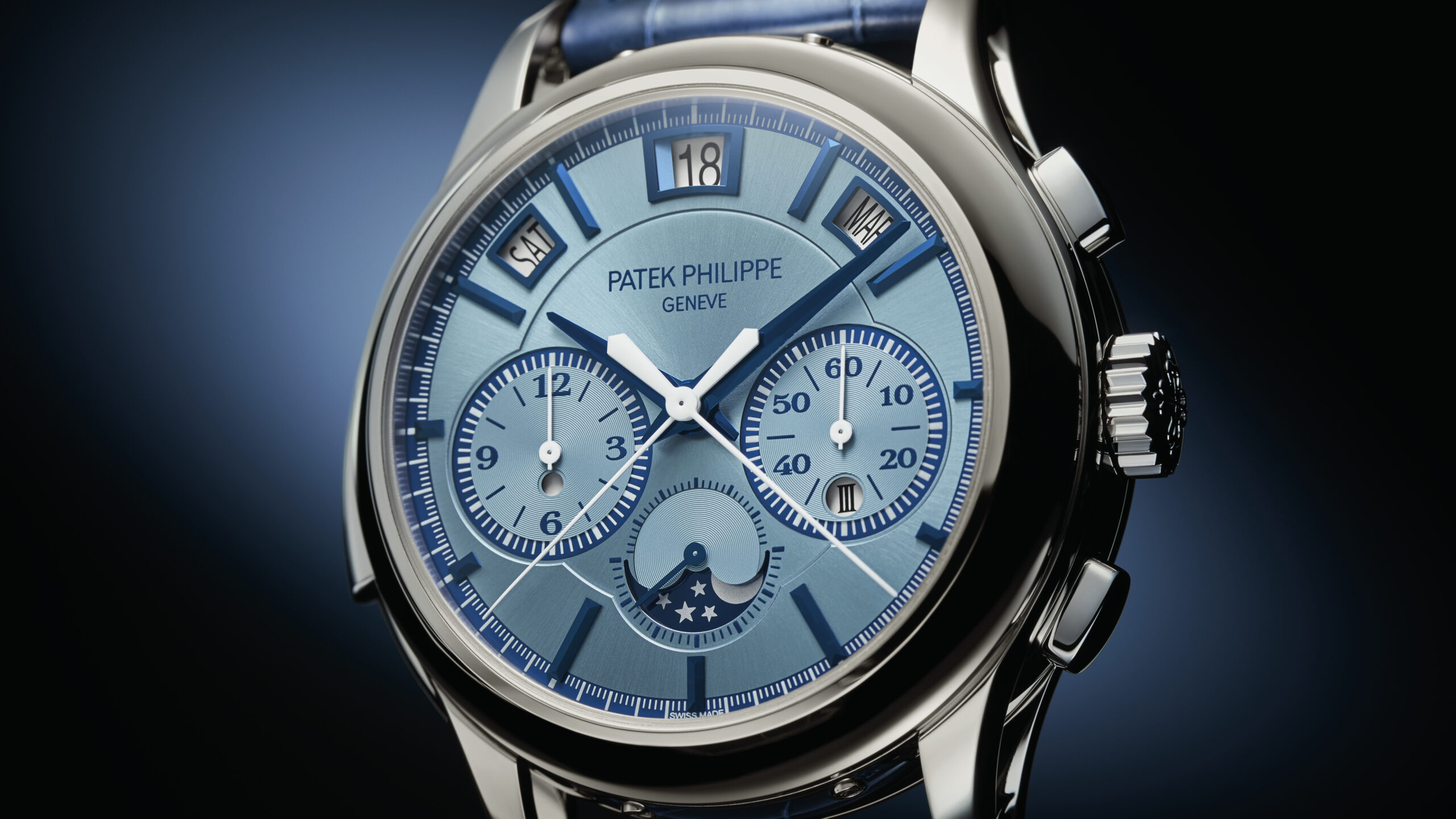
Ref. 5308G-001, introduced for Watches and Wonders Geneva 2025, is where these threads are drawn together. Officially described as a “quadruple complication”, it combines a minute repeater, a split-seconds monopusher chronograph and an instantaneous perpetual calendar. It is self-winding with a platinum micro-rotor.
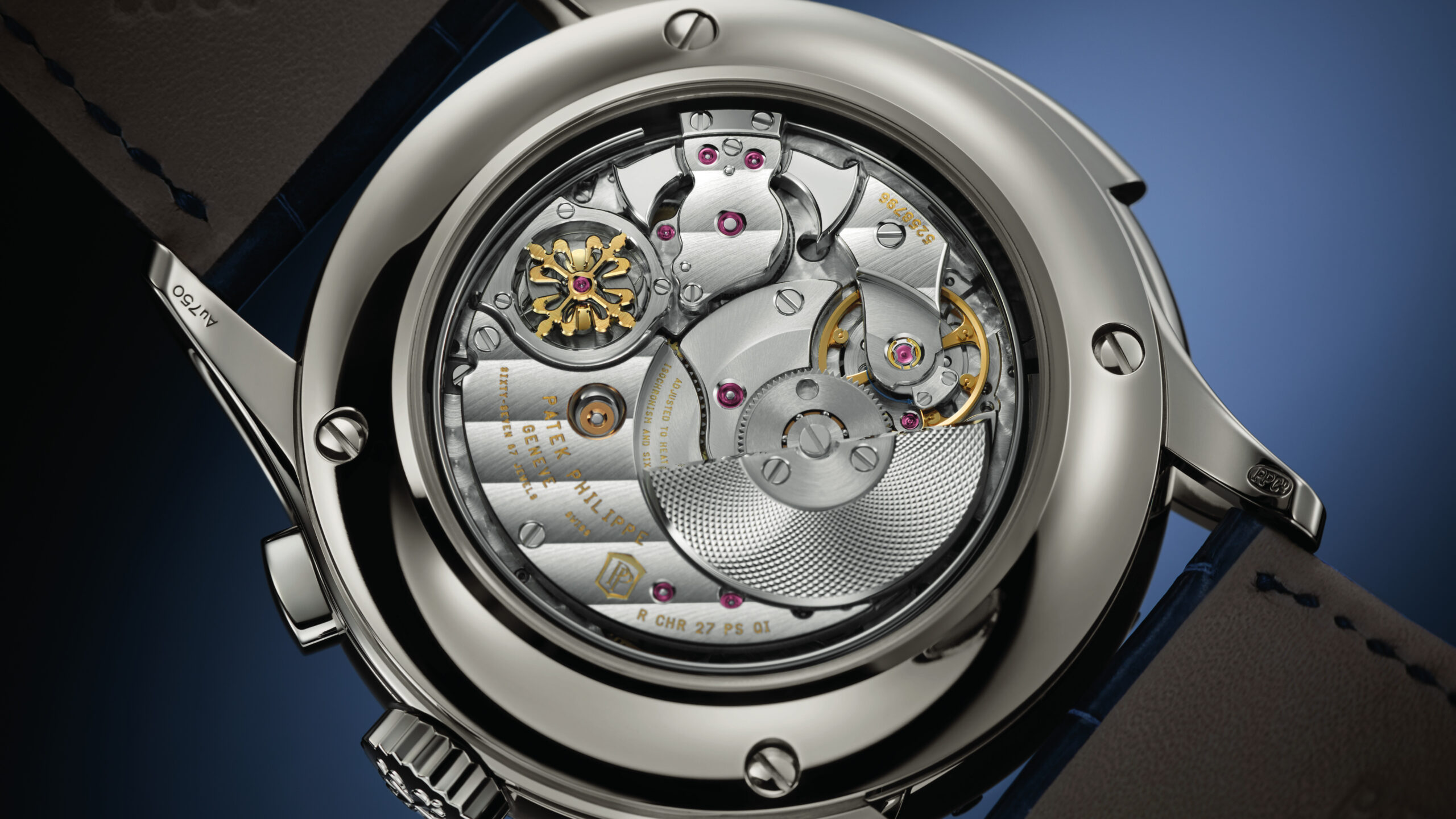
The movement, calibre R CHR 27 PS QI, descends from the R 27 PS QI of Ref. 5208 but adds a full split-seconds chronograph on top of the minute repeater and instantaneous perpetual calendar. It measures 32mm in diameter and is 12.28mm thick, contains 799 components and is wound by the aforementioned recessed micro-rotor. The micro-rotor architecture keeps the overall height within wearable bounds and leaves a generous view of the movement through the display back.
From a technical perspective, the key achievement of Ref. 5308 is not simply that these four complications coexist, but that they do so in a way that preserves the integrity of each. Three areas in particular deserve closer attention: acoustic isolation and power management for the repeater; friction control and isolator design for the split-seconds chronograph; and energy storage and release for the instantaneous perpetual calendar.
The minute repeater is driven by a separate barrel and gear train dedicated to the chiming work. When the slide is actuated, the strike train draws power from this barrel to drive the racks, snails and hammers that sound the hours, quarters and minutes on two classic gongs. To maintain consistent volume and tempo, the calibre uses a centrifugal governor with aerodynamically shaped blades that regulate speed while producing minimal mechanical noise of their own. The construction ensures that neither the going train nor the chronograph train interferes with the flow of power to the repeater while it is in action, which is crucial for both acoustic purity and rate stability.
The split-seconds chronograph in Ref. 5308 is monopusher in layout but fully fledged in function. Start, stop and reset are controlled by a single pusher at 2 o’clock; the split- seconds function is activated by a second pusher at 4 o’clock. The movement uses twin column wheels to coordinate the chronograph and rattrapante functions and an isolator system to prevent the clamped split-seconds wheel from loading the chronograph train. The steelwork is finished to the same standard as the CHR 29-535 family – even where a lot of these elements are not even visible from the caseback – with black-polished column-wheel caps, straight-grained levers, rounded and bevelled edges and mirror- finished hammers.
The perpetual calendar is of the instantaneous jumping type, with day, date and month displayed in a broad arc of apertures across the upper half of the dial, complemented by leap- year and day–night indications. Patek Philippe has engineered the system so that the three main calendar discs jump in roughly 30 milliseconds, regardless of whether the month has 28, 29, 30 or 31 days. Two opposed jumper springs of equal strength act on the date, balancing each other so that the force required to advance the disc remains essentially constant from month to month. This stabilises amplitude at the precise moment of switching, which is particularly important in a watch where other energy-hungry complications are present.
On the dial side, the 5308G wears its complexity with some restraint. The ice-blue sunburst dial, with its faceted baton markers and arched calendar windows, reads more like a contemporary Patek Philippe perpetual calendar at first glance than a four- complication statement piece. Only on closer inspection do the extra pushers, repeater slide and twin chronograph registers give the game away.
In the context of Patek Philippe’s split-seconds story, Ref. 5308 occupies a very specific place. It is not a laboratory prototype or a one-off special order, but a catalogued watch that distils much of the brand’s accumulated knowledge into a single reference. It is, in effect, the grand synthesis to which the 1923 wristwatch, the CHR 27-525 PS, the CH 29-535 PS and Ref. 5204 have all contributed.
REF. 5370 AS LENS, REF. 5308 AS HORIZON
Taken together, these watches describe a century of thought about how to measure the shortest intervals of time, and how to reconcile that task with other demanding complications.
The 1923 no. 124.824 shows Patek Philippe grappling with the basic question of how to fit a split-seconds chronograph into a wristwatch at all, and doing so with such success that its architecture can be revived a hundred years later. The early wrist- worn rattrapantes, references 130, 1436 and 1563, demonstrate that the manufacture was prepared to let the complication live in real and wearable cases. Ref. 1518 establishes a second, parallel line of enquiry by combining chronograph and perpetual calendar in a serially produced watch, a line that runs unbroken through references 2499, 3970 and 5970 to the fully in-house references 5270 and 5204.
The CHR 27-525 PS family and the CH 29-535 PS family mark the decisive move to in-house chronograph calibres, each embodying a different approach to thinness, layout and complication load. Their patents and refinements, from optimised tooth profiles to improved isolators, are the invisible scaffolding beneath the graceful sweep of the chronograph hand.
Ref. 5370 stands at the centre of this constellation. It is the watch that best allows a collector to see, via one open caseback, what Patek Philippe currently thinks a split-seconds chronograph should be. Ref. 5204 shows how those ideas can be integrated into the long-standing Patek Philippe language of perpetual calendar chronographs. Ref. 5373 demonstrates that even in this rarefied field, ergonomics and playfulness still have a place.
The Ref. 5308G-001, finally, is the horizon. It gathers minute repeater, split-seconds chronograph, instantaneous perpetual calendar and micro-rotor automatic winding into a single, precisely choreographed whole. In doing so, it turns the split-seconds chronograph from the protagonist into one of several lead players. The rattrapante is no longer an isolated display of virtuosity, but part of a broader composition about how far a wristwatch can go while remaining, just about, wearable.
In that sense, the story that begins with a unique 33mm gold watch made in 1923 now continues in a white gold watch that represents one of the most mechanically ambitious Patek Philippe wristwatches ever placed into regular production. Between them stands Ref. 5370, the contemporary rattrapante that makes clear why this complication continues to fascinate watchmakers and collectors alike: because it is, quite simply, one of the most eloquent ways to measure a human moment.
PHOTOGRAPHY CHING@GREENPLASTICSOLDIERS
STYLING AND ART DIRECTION AUDREY CHAN
ADDITIONAL WATCH IMAGES COURTESY OF PATEK PHILIPPE AND PHILLIPS
This story was first seen as part of the WOW #82 Festive 2025 Issue
For more on the latest in luxury watch reads, click here.
The post A Century in Split Seconds: Patek Philippe’s Chronograph Legacy appeared first on LUXUO.